
by admin | Dec 12, 2021 | Behind the Bucking Chutes
By Scott Hilgendorff / Cowboys of the Cross
From nativity scenes to Christmas specials, we have the idea that the three wise men, or Magi, were there with the shepherds to see the baby Jesus in the stable.
Scripture tells us something different.
These men, called magi, were likely priests from an eastern culture like Persia, led by what appeared to be a star, to see the king they had heard about.
King Herod, like most, did not fully understand that Jesus was not here to replace his rule, but for a much greater purpose that would pave the way for all to be able to find salvation through his eventual death on a cross. He asked the Magi to report back to him the location of this king, lying about his intent to have the baby killed.
The Magi were warned in a dream to not return to Herod who was left without the location of Jesus.
Instead, what we have is a very grim part of the Christmas story in which Herod then ordered all children two years or younger to be killed.
Matthew 2:16 When Herod realized that he had been outwitted by the Magi, he was furious, and he gave orders to kill all the boys in Bethlehem and its vicinity who were two years old and under in accordance with the time he had learned from the Magi.
Verse 11 told us the ‘wise men’ arrived to see Jesus at a house, not a stable, and in this verse, we see it was as much as two years after Jesus was born.
Those who work in the rodeo and horse industries know how animal rights activists have extremely wrong ideas about the treatment of animals.
Much of their information is passed on from person to person and without digging in to learn from accurate information, they simply believe what they have been told, without question.
The lesson for us in this story about the wise men is the importance of taking our Biblical knowledge directly from scripture.
What we assume we know from what is passed on by others isn’t always true. It’s how most people generally overlook the fact that when we die, we don’t actually ‘get our wings’ or become angels.
Psalm 8:5 You have made them a little lower than the angels and crowned them with glory and honor.
The “them” being referred to in the Psalm is humans, while Genesis 1:25 describes the types of angels God created and 1 Corinthians 6:3 references people judging angels. The distinction is clear that people and angels are never the same.
Following these common misunderstandings about the Bible don’t cause harm to God’s plan for our salvation, but they show us the need to not just rely on what we think we know about the Bible, but to dig in for ourselves to all that God’s word has to offer us.
The Christmas story is a far more beautiful story when we understand it correctly and how it shows us just how much God loves us. We need to understand the story starts with the birth we are celebrating but it leads to Jesus’s death on the cross and resurrection so that through faith in who Jesus was and is and by asking to be forgiven of the sins that separate us from God, we can be given an eternal home with him in Heaven–not as angles but as the perfect creation God made us to be.

by admin | Dec 2, 2021 | Strengthening Your Grip
By Jesse Horton / Cowboys of the Cross
In every church – every local body of believers – you have apostles (the ones who are good at start-ups and new adventures), prophets (the ones who declare the word of God clearly), evangelists (the ones who share Jesus with others naturally in almost everything they do), the pastor-teachers (the ones who are gifted to lead other believers and to attend to the spiritual health of the body), and the saints (all believers, but including laypersons in the body of Christ). Most people reading this will find themselves in that last category – non-clergy who are members or attendees of a local church. I am thankful for you, and I want to encourage you today about your very important role in the body of Christ.
In 2 Corinthians 5:17-20 the Apostle Paul writes,
“Therefore, if anyone is in Christ, he is a new creation. The old has passed away; behold, the new has come. All this is from God, who through Christ reconciled us to himself and gave us the ministry of reconciliation; that is, in Christ God was reconciling the world to himself, not counting their trespasses against them, and entrusting to us the message of reconciliation. Therefore, we are ambassadors for Christ, God making his appeal through us. We implore you on behalf of Christ, be reconciled to God.”
Here, Paul refers to himself and Timothy as “ambassadors for Christ.” They are set apart as Jesus’s representatives; their actions and words are Jesus’s command to them lived out before the eyes of the people of Corinth, a plea to them to “be reconciled to God.” Clearly, Paul and Timothy were ambassadors of Christ actively involved in God’s plan of redemption. Does God’s plan of redemption dictate that all who believe are ambassadors of Christ, or is there an allowance for spectator Christians – laypersons who aren’t involved in ministry?
In Ephesians 4:11-16, Paul wrote,
“And he gave the apostles, the prophets, the evangelists, the shepherds and teachers, to equip the saints for the work of ministry, for building up the body of Christ, until we all attain to the unity of the faith and of the knowledge of the Son of God, to mature manhood, to the measure of the stature of the fullness of Christ, so that we may no longer be children, tossed to and fro by the waves and carried about by every wind of doctrine, by human cunning, by craftiness in deceitful schemes. Rather, speaking the truth in love, we are to grow up in every way into him who is the head, into Christ, from whom the whole body, joined and held together by every joint with which it is equipped, when each part is working properly, makes the body grow so that it builds itself up in love” (emphasis mine).
This suggests that everyone in the body of Christ – every believer – has a role to serve in the building up of the body of Christ. As “each part [of the body] is working properly,” the whole body becomes a healthier, clearer representation of God’s redeemed people. In Colossians 3:12-17, Paul instructs,
“Put on then, as God’s chosen ones, holy and beloved, compassionate hearts, kindness, humility, meekness, and patience, bearing with one another and, if one has a complaint against another, forgiving each other; as the Lord has forgiven you, so you also must forgive. And above all these put on love, which binds everything together in perfect harmony. And let the peace of Christ rule in your hearts, to which indeed you were called in one body. And be thankful. Let the word of Christ dwell in you richly, teaching and admonishing one another in all wisdom, singing psalms and hymns and spiritual songs, with thankfulness in your hearts to God. And whatever you do, in word or deed, do everything in the name of the Lord Jesus, giving thanks to God the Father through him” (emphasis mine).
Not only should we be teaching, admonishing, encouraging, and building one another up toward mature faith in Jesus, but everything we do should be done in the name of the Lord Jesus! That’s precisely what it means to be an ambassador, but here it is applied not to Paul and Timothy, but every believer in Colossae!
According to Paul, every believer has a responsibility to every other believer to encourage spiritual health and maturity (Eph. 4:11-16), but every believer also has a responsibility to those who are still strangers and aliens to God’s kingdom to represent Jesus Christ before them, imploring them to be reconciled to God (2 Cor. 5:17-20; Col. 3:17).
Here’s what I want you to know: Paul didn’t present these instructions to the church as some radical new idea for God’s kingdom work. Rather, he presents the ambassadorship of every believer as the normal plan and expectation for members of God’s kingdom; there is no allowance for spectator Christianity. Such total missional involvement only seems radical because our churches have created and embraced a missional model that is far from God’s normal plan.
For many, many people who attend church, attendance is the spiritual equivalent of going to a concert. They experience the religious performance of ministry professionals, but they are not committed to the health of the church nor are they involved in its redemptive mission to the world. Their relationship with the church is self-serving (“This is the kind of church experience I want and the benefits it should offer”) and passive (“I’m thankful for the work the church staff and volunteers do”). That is far from God’s plan. God makes his invisible grace visible by sending his people (clergy and laypersons alike) – full of his grace – to reflect his grace to people who need it. And we know many in the rodeo community choose not to attend a traditional church for a host of reasons and excuses. But where you stand with church, Christ’s call on you is the same as everyone else.
If, indeed, you have been called by Christ, you have been called for this purpose. Your life no longer belongs to you, for you have been bought with a price. Everything you are, everything you possess, and all the time you have left belongs to God for his mission and his purpose. Run with me today to the throne of grace; be filled to overflowing, and then go serve as ambassadors for Christ wherever you find yourself. Thank you for serving with me in the kingdom of God!
Grace and peace be with you!
Pastor Jesse
by admin | Nov 18, 2021 | Strengthening Your Grip
By Jesse Horton / Cowboys of the Cross
We all do it many times every day; most often, we do it unconsciously. What we conclude when we do it says a lot about who we think we are and what we think we are up against. Toddlers learning to walk do it. Elderly folks facing serious illnesses do it. Yes, we all measure our capabilities against whatever task lies before us.
We attempt to determine our ability to manage the obstacles ahead to achieve what we consider a successful outcome. We place our abilities alongside every challenge to see which is greater, and often we avoid challenges that seem to surpass our abilities. Some look at the rodeo schedule and choose to enter a deal where they know they stand a better chance of winning because of the stock that’s there.
None of this is wrong or irrational.
It makes sense to discern whether we have the skill set, the resources, the strength, and the influence to achieve success when we face a challenge. But when we look to our own experiences, resources, and talents we fail to consider something that is drastically more important – the good news that we who are in Christ are no longer bound by our limited human nature.
Galatians 2:20 “I have been crucified with Christ. It is no longer I who live, but Christ who lives in me. And the life I now live in the flesh I live by faith in the Son of God, who loved me and gave himself for me.”
God is not surprised by any circumstance you have ever faced, nor will he be surprised by what awaits you in the days you have ahead. He knows every temptation you will face, every sin to which you will succumb, every sorrow and suffering that will bring you down, and every triumph and joy that will raise your spirits.
Knowing all of these things, he gave you exactly what you need so you can be who you’re supposed to be and do what you’re supposed to do even in the midst of this broken, rebellious world. What did he give you? He gave you himself! His grace isn’t insight. It isn’t a change of location or an altering of circumstances. He is the grace that he gives! That means that our potential as his children is much greater than the sum of our past experiences, our gifts and talents, our resources, and our strengths.
Our ability to overcome is infinite because the Almighty God who spoke everything into existence, who raised Christ from the dead, and who will one day make all things new and perfect again has made you his home. “No, in all these things we are more than conquerors through him who loved us” (Romans 8:37). There is nothing to which God has called you that he has not also given you victory as you abide in (obey!) the love of Christ.

by admin | Nov 18, 2021 | Behind the Bucking Chutes
By Scott Hilgendorff / Cowboys of the Cross
“They’re just words.”
There’s recently been a lot of discussion and debate about the tv series Yellowstone, started by an article from RFD TV, about the language in the show.
People seemed evenly split on whether they watch the show or not based on the language and content of the show. But observations were made that when someone complained about the language in online discussions, it led to attacks against them by the people defending the language.
Reading through some of it, the most common comment I kept hearing about the language was that they were just words.
Thing is, many of the people on either side identify themselves as Christians and we do in fact need to be really careful that we understand the significance of words.
Why? Because of numerous verses across the Old and New Testaments of the Bible that tell us how important words are.
One verse to start with is this:
Ephesians 4:29 Do not let any unwholesome talk come out of your mouths, but only what is helpful for building others up according to their needs, that it may benefit those who listen.
It makes it clear that language that isn’t wholesome shouldn’t be spoken. Instead, it directs us to speak words that would work toward making life better for another person. The words we speak should only do good.
Look at just a few ways Proverbs shows us the importance of good words.
Proverbs 16:24 “Kind words are like honey–sweet to the soul and healthy for the body.”
Proverbs 15:4 “Gentle words bring life and health; a deceitful tongue crushes the spirit.”
Proverbs 18:4 “A person’s words can be life-giving water; words of true wisdom are as refreshing as a bubbling brook.”
Proverbs 20:15 “Wise speech is rarer and more valuable than gold and rubies.”
But it gets even more serious in the Book of James which has much to say about words and the importance of controlling our speech because of what it is capable.
James 3:6 The tongue also is a fire, a world of evil among the parts of the body. It corrupts the whole body, sets the whole course of one’s life on fire, and is itself set on fire by hell.
In this verse specifically, James warns us that we can be completely corrupted by our tongue, the words we speak. He describes our tongue as a fire and that we can basically release hell on earth through what we say to people.
Throughout the whole chapter, James warns us that we can speak terrible things and do great harm or we can use words to bring life to others. The most important words we can speak are the words that describe the gospel and how to find a saving faith in Jesus Christ.
This is why it’s important not to downplay the words we speak and the words we listen to. They can influence for good, the gospel and Jesus, or they can influence for evil.
The words we speak aren’t, ‘just words.’
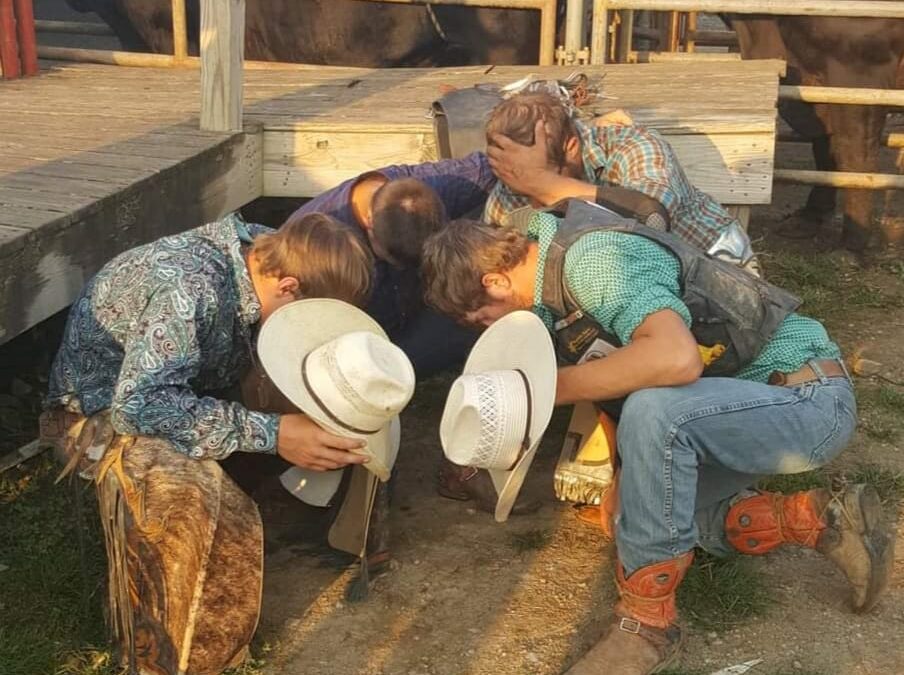
by admin | Nov 4, 2021 | Behind the Bucking Chutes
By Scott Hilgendorff / Cowboys of the Cross
I choose love.
Not words you look to hear from a cowboy with a reputation of toughness to uphold. But that’s not the love I’m talking about. I choose this love.
John 13:34 A new command I give you: Love one another. As I have loved you, so you must love one another.
Jesus loved me enough to die for me and take the punishment meant for my sins. All I have to do is believe, repent and ask to be forgiven and thanks to his love, I can have an eternal and perfect life in Heaven. His love was an action, not a feeling.
I choose love.
It’s a command from Jesus but in a world where we’re divided, fighting with and hating on each other, does he really need to command me?
I choose love. I choose to say, “Hey buddy, I know you barely scraped your fees together tonight to get jerked down like that. I’ve got some extra, let me buy your Taco Bell.”
I choose love. I choose to hold my tongue when the waitress just gave me attitude and instead, ask how I can pray for her when the check comes.
I choose love. I choose to spend some time coaching a gunsel instead of giving up on him or just laughing when he walks by with his spurs upside down and his chaps on an hour and a half before showtime.
I choose love. I choose to cheer for my rival who is about to win the team roping championship after my horse walked through barbwire this morning.
I choose love. I choose to stop by the hospital and check on the guy who got stomped even though he sucker-punched my traveling partner last week for talking to his girl a little too much after the rodeo.
I choose love. I choose to pray for you even though you may never know I’m doing it. I choose to tell others what is good about you or keep my mouth shut. I choose to help you without you knowing it isn’t convenient.
Do I blow it sometimes? Absolutely. Do I repent and apologize or make amends? I try to. Can I do better? Yep. Grace lets me mess it up but Jesus’s love motivates me to do better. I choose that love. I don’t have to like you to love you. You don’t have to like me for me to love you. This love is action and it’s a lot harder than hate or anger. It takes sacrifice, it takes time. It takes putting someone else first. I choose to do what’s hard. I choose to walk into the stampede of anger.
I choose love.

Recent Comments