
by admin | Feb 18, 2026 | Power in our Words
By Scott Hilgendorff / Cowboys of the Cross
There’s an expression that sometimes circulates on social media in posts or memes—that the best sermon is lived, not preached.
There’s good intentions in this, but it can really misdirect us.
Our words are incredibly important for two reasons: so that our actions line up with what we say we believe about the Bible and so that we can clearly communicate the gospel. We can live a Christ-like life but if we can’t help people understand what it means to have a saving faith in Jesus, our actions help no one with their eternity.
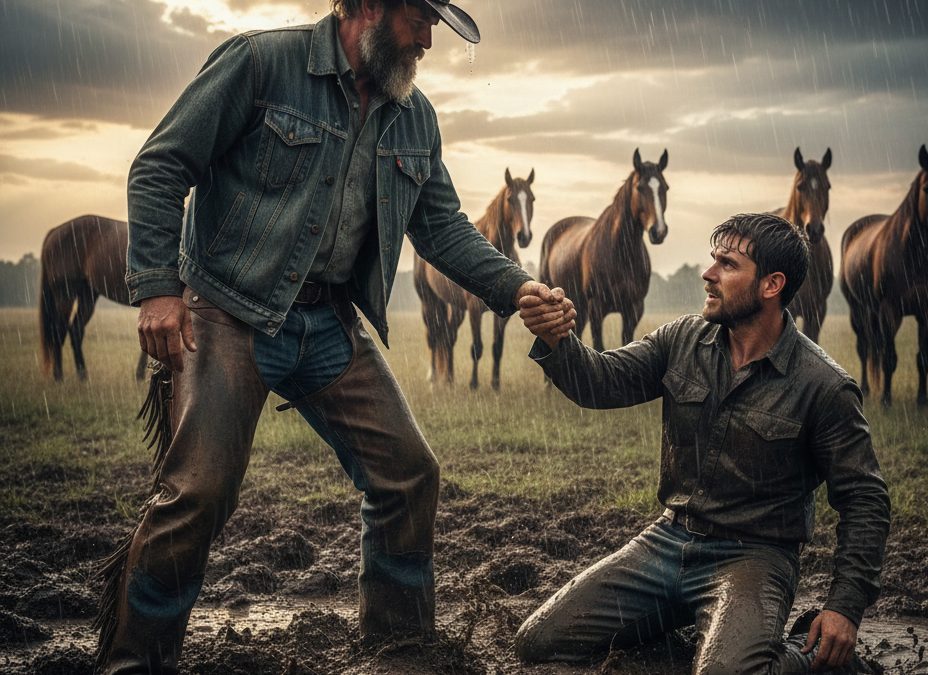
People want to know why we live differently; why our actions might be different than those. Why did you give money to that homeless guy when you know he’s going to buy drugs? Why didn’t you just knock that guy right off the bucking chutes for acting like that back there? Why would you shake that rodeo judge’s hand when he’s cheated you out of the finals two years in a row?
Even if they don’t come right out and ask it, our actions lead to questions in their thoughts but if they also hear us speak about our faith, they can obviously connect it all together as having something to do with Jesus and the door might open to tell them about our faith if we haven’t found a way to bring it up already.
But how we live our lives and the Christ-centered reasons we give for it can lead to people hating us or challenging us.
1 Peter 3:15-17 but in your hearts honor Christ the Lord as holy, always being prepared to make a defense to anyone who asks you for a reason for the hope that is in you; yet do it with gentleness and respect, 16 having a good conscience, so that, when you are slandered, those who revile your good behavior in Christ may be put to shame. 17 For it is better to suffer for doing good, if that should be God’s will, than for doing evil.
The hope Peter is referring to here isn’t the same as hoping for a certain outcome, it’s about those with a saving faith in Jesus understanding there is nothing here for us compared to what is to come in an eternity in Heaven. Our hope or trust isn’t in anything from this world but in Jesus and heaven.
Peter wants us to live out a life that honors Jesus and his holiness while being able to tell people how to get to heaven through Jesus’ sacrifice on the cross, repentance or our sin and a desire to be forgiven in the understanding Jesus took the punishment that was otherwise meant for our sin.
Peter stresses the importance of how we live our lives, that it can actually lead to suffering in a culture that hates Christian beliefs but because of our efforts to live like Jesus, it makes those who come up against us look shameful.
But he also stresses we have to be prepared to defend our faith and share the gospel with others. Our words are necessary to explain that sermon we are living out.

by admin | Feb 5, 2026 | Behind the Bucking Chutes
By Caleb Crouch / Cowboys of the Cross
Do You Ever Ask Why?
Here’s a few words from Jesus Himself:
Matthew 5:45 AMPC “…for He makes His sun rise on the wicked and on the good, and makes the rain fall upon the upright and the wrongdoers [alike].”
It’s fully human to ask “why.”
But, it’s the enemy’s desire to create doubt toward God during these awful moments that cause us to ask this realistic question.
◦ It’s vital to understand Who is in control.
◦ It’s vital to understand the only just One.
◦ It’s vital to understand Who’s on your side.
◦ It’s vital to know that God makes no mistakes, if He allows it or brings you to it, He will bring you through it!
◦ It’s vital to accept the forbidden earthly journey, and say as Christ also said in the last moments of the garden: “Not My Will, But Thy Will Be Done.”
◦ It’s vital to surrender to whatever the Father allows, decides and wants — He will continue His work, working in and through you, and He will continue working ahead!
◦ God will be Who He’s always been, through eternity, and so will our adversary.
◦ One day, the adversary and all his slaves will be in hell forever!
◦ That same day, all who have chosen God — will be in heaven forever!
Guard yourself, if you ask “why,” just know there’s two directions this can lead you: to God or digging deeper into who God is, recognizing our dependence on Him and humility in our true position.
◦ Guard to always choose your trust God
◦ Guard to resist the devil and his awful lies, plans, and terror.
◦ Guard to not mislead those around.
God will always, always, always come through.
God is always working, even in the face of impossibility.
God will bring you through it, if you can stand the pull!
His presence has never been limited by man’s limitations!
It’s okay to ask “why,” but do it with humility toward God, surrender to Him which will likely need you to fill that gap, and to understand you belong to God.
God knows where we are, exactly what we face, and most important: He cares about you!
Going further by Philip Crouch:
It is okay to ask “why,” but I must make sure the attitude of my heart is right.
This is accomplished by remembering that God is good (always) and any evil that may befall me cannot come from Him (even though He allows it). “God is light and in Him is no darkness at all.” 1 John 1:5
This is accomplished by practicing “in everything give thanks” 1 Thessalonians. 5:18. This is easy to do in the good times but also easy to forget to do. It’s vital that I make this a habit during the “good times” so that when the hard times come praise and thanksgiving to God will be my first instinct.
This is accomplished by remembering “that all things work together for good to those who love God, to those who are called according to His purpose.” Romans 8:28
Choose praise over complaining.
Choose trust over fear.
Choose thanksgiving over want.
Choose peace in the midst of turmoil.
Choose joy in times of grief
This is how I guard the attitude of my heart when asking “why.”

by admin | Feb 5, 2026 | Power in our Words
By Scott Hilgendorff / Cowboys of the Cross“I’m sorry for what I said when we were working with cattle.”
That’s a form of a joke we see about how working with horses and cattle can bring out the worst in us, particularly causing us to swear or have angry outbursts.
We all know the idea of taking a breath and counting to 10 to give us time to calm down but there’s also a biblical way to do this.
James 3 tells us about how much power our words have to do great harm. He uses the example of a bit in a horse’s mouth or the rudder of a ship to make clear how something that seems so small is capable of controlling the direction we take. It can lead us into great evil with the power to destroy. In studies in bullying, there’s research that shows how girls tend to stay on another girl they target relentlessly from face-to-face confrontations to attacks across social media. They are capable of using their words to push someone to suicide though this has happened in both boys and girls.
James isn’t exaggerating in how much evil our words can do. He calls them a ‘restless evil’ and a ‘deadly poison.
I’ve witnessed rodeo cowboys spread rumors that have forced someone to leave the industry even though they knew the stories were likely to be false.
James 3:3-8 When we put bits into the mouths of horses to make them obey us, we can turn the whole animal. 4 Or take ships as an example. Although they are so large and are driven by strong winds, they are steered by a very small rudder wherever the pilot wants to go. 5 Likewise, the tongue is a small part of the body, but it makes great boasts. Consider what a great forest is set on fire by a small spark. 6 The tongue also is a fire, a world of evil among the parts of the body. It corrupts the whole body, sets the whole course of one’s life on fire, and is itself set on fire by hell. 7 All kinds of animals, birds, reptiles and sea creatures are being tamed and have been tamed by mankind, 8 but no human being can tame the tongue. It is a restless evil, full of deadly poison.
James makes the point that no human can bring the tongue under control. While it’s easier to choose not to intentionally do harm or spread gossip, it’s so easy to say harmful words in anger.
Earlier in his book, James addresses part of this in James 1:19 saying “My dear brothers and sisters, take note of this: Everyone should be quick to listen, slow to speak and slow to become angry.”
Now, James seems to be telling us there’s nothing we can do about it but he’s saying no human can tame the tongue, he isn’t saying that it can’t be. We serve and worship a God who can control everything. Instead of taking a breath and counting to 10, we need to take that breath and pray for God to take our anger away or to give us the right words to say.
God will control our tongue if we let Him and we can hold back from doing genuine evil in the world around us.
by admin | Jan 12, 2026 | Power in our Words
By Scott Hilgendorff / Cowboys of the Cross
The words we speak to someone have the power to be someone’s breaking point or they can become that person’s turning point
The Bible teaches a lot about the power of our words. In Ephesians, Paul gives us some encouragement in what we should say and why.
Ephesians 4:29 Let no corrupting talk come out of your mouths, but only such as is good for building up, as fits the occasion, that it may give grace to those who hear.
First, Paul instructs us not to speak gossip, vulgarities, profanities, anything that would harm what it looks like to be a follower of Jesus.
Instead, he wants our words to be directed toward lifting others up.
In the rodeo community, the cowboy crowd is actually used to doing that. Whether on the timed event of the arena or the rough stock, we all know how to lift another person up, either with praises about the run or ride they had or encouragement if they missed their catch. Constructive criticism is welcome and serves to build that person up by helping them improve and learn from where they might have gone wrong.
The same needs to be extended to the world around us. That can be a lot harder. It’s easier to be unkind to total strangers. Social media has made that easier for us but now it carries over into the real world and the people we interact with there. It should be easy to hold our tongue when a server in a restaurant is terrible or when our wives or girlfriends get under our skin. And better yet, we should be looking for opportunities to lift that person up. God puts people in front of us every day who we have no idea what they are going through, good or bad.
Speaking angrily or in frustration and being unkind can be the last straw for that person while offering a kind work or encouragement can be what gives someone at the end of their rope the real hope they needed.
And when someone has been torn down by corrupting talk, it’s a lot harder for someone else to come along and build someone up when they have a lot further to go. A foundation of kind words and encouragement that you’ve already left means the person gets lifted even higher if the next person comes along with a positive comment.
Sure we all have people we don’t like. Sometimes we’re given good reason to not like that person. The expression, “if you can’t say anything good about someone, don’t say anything at all,” really kicks in at that moment. We can at the very least avoid them or refrain from gossping to someone else. Better yet, Paul wants us to still find a way to be encouraging.
Why does that matter? When Paul says our encouragement gives grace to others, what it does is opens up the opportunity to tell others what it means to have a saving faith in Jesus. We are never going to find opportunities to bring that up in conversation with someone who we have torn down. And if we’re known to be Christians, it makes it harder for the next person to share Jesus is the example we have set has been discouraging instead of encouraging.
Look for opportunities in front of you this week to be an encouragement.

by admin | Dec 13, 2025 | Behind the Bucking Chutes
By Scott Hilgendorff / Cowboys of the Cross
Chances are, Jesus wasn’t born in a stable. That doesn’t make his birth any less humble.
The idea of donkeys and cattle being gathered around is not as likely either.
Those ideas, while appealing to cattlemen, ranchers and cowboys, came along later and now, we grow up singing Christmas carols and songs that reference them and as kids, we grew up with television specials that depicted those kinds of images. Those images are everywhere from expensive pieces of art and home decor to jigsaw puzzles and Christmas cards. It’s understandable that we would make these assumptions when we consider the Christmas story.
I remember as a new believer, hungry to learn more from God’s word every day, that I was looking forward to adding reading what we call the Christmas story from Luke 2, into my Christmas traditions. Christmas morning, I opened my Bible and settled in to read through it. By verse seven, it was all but over in less than a minute of reading.
Luke 2:7 “And she gave birth to her firstborn son and wrapped him in swaddling cloths and laid him in a manger, because there was no place for them in the inn.”
There was no urgent knocking on doors in effort to find a place to stay as Mary was in labor. There was no description of the stable or animals gathered around. The story does continue with an angel of the Lord appearing before shepherds and of their journey to see the newborn Savior but there are very few details describing that manger scene we can all picture in our minds.
The manger, a feeding trough, is our clue that there likely were animals present and Jesus’s birth most certainly was still humble, but according to Steve Mathewson from an article with The Gospel Coalition. Most English translations of the Bible use the word inn but the Greek word being used is “katalyma” which, in two other places of the Bible, Mark, 14:14 and Luke 22:11, translate to “guest room.”
In that time period, historical understanding tells us there was often a downstairs room where animals might be kept for their heat and to keep them protected and it’s likely because there was no room in the guest room where they hoped to stay, Jesus was born in a downstairs family room where a feed trough, a manger, would still be present to feed the animals brought in there at night.
It just doesn’t leave room for donkeys and cattle.
It doesn’t mean we should stop singing, “Away in a Manger” and “The Little Drummer Boy;” it means we need to remind ourselves how careful we have to be with God’s word. It’s easy to let our culture influence how we interpret scripture when it’s scripture that needs to influence our culture.
As we think about the Lord’s humble birth and being placed in that manger, a powerful scene from our Christmas stories of an angel of the Lord appearing to a group of shepherds, an ancient version of modern cowboys, to tell them of Jesus’s arrival.
Then, even more stunning, in Luke 2:13, “Suddenly a great company of the heavenly host appeared with the angel, praising God…”
The shepherds went to see Jesus and from all their experiences, went home praising and glorifying God.
Whether or not Jesus was born in a stable, Jesus’s birth was still both humble and spectacular from the manger to the presence of countless angels before the shepherds.
These are details we know for certain from Scripture and are our inspiration to praise the arrival Jesus just the same as the shepherds this Christmas season, letting our celebration be one that praises God for what He did for us in sending a Savior to die for our sins. His death and resurrection gives eternal life to those repentant of their sins, seeking forgiveness through a saving faith in who Jesus was, born that day in a manger, and who he is now in Heaven.

Recent Comments