The past year, on top of the personal struggles we face, we were all dealing with struggles that the pandemic brought from lock downs to canceled rodeos and horse shows.
Lost work, lost business, lost time with family gave us a lot to feel angry about.
And everyone knows it.
Whether it be on social media or face-to-mask conversations, we all have had a lot to say about how we feel and very little of it has been positive or encouraging. In the rodeo and bull riding industries, we continually talk about mindset and keeping positive attitudes. We rarely talk about that from a faith perspective.
The apostle Paul does in many ways in several of his letters. In Philippians, his letter to the church at Philippi, Paul writes many encouraging passages about being cheerful and Christ-like in our mindset and responses to our situations including one encouragement about our attitude when life might be rough.
Philippians 2: 14-16 Do all things without grumbling or questioning, that you may be blameless and innocent, children of God without blemish in the midst of a crooked and twisted generation, among whom you shine as lights in the world,
When we have a saving faith in Jesus, we are given what’s known as the Great Commission to respond to at the end of the Book of Matthew. The commission commands us to tell others about Jesus and the salvation he brings and then to make disciples—teach others how to follow Christ.
That means being out there in an unbelieving world that generally rejects the messages of Jesus or sees him as no more than a positive teacher back in his day.
But if we are to convince others that Jesus was the Son of God who died in place of our sins that through belief and repentance of our sins, we can be saved from the punishment meant for our sins, it’s going to be a lot harder if they can’t see signs of Jesus in us.
The amount of complaining and fighting many of us have done over the past year would make it hard for others to see us as different than them. If our lives have been changed by a saving faith in Jesus, there are times when our actions or responses should surprise people by how different they are from everyone else.
Paul wanted the Christians in Philippi to be seen as ‘children of God’ that stood out among the evil that was around them and showed the light of Christ.
As Christians, we’re called to be like Christ, but we understand we’ll never truly be as perfect as him. We’re going to make mistakes. Admitting them to an unbelieving world and telling them that as Christians, we meant to do different is one step toward repairing any damage from our words or actions. Moving forward by ending our grumbling and taking a more joyful or kind approach to our situations can begin to show others that Christ lives inside of us.
Do you know that God loves you and cares for you like his very own child? No, really. Do you know that? I bet everyone who is reading this letter first-hand has heard it. Many of you have probably agreed with it and even affirmed it in your own words. But my question is, has this truth actually moved from your head to your heart and begun to affect your life? It almost seems like a totally different question because it is! Agreeing with the statement, “God loves and cares for me like his own child,” is entirely different from livingout in our actions and thoughts that God loves and cares for us like his own children.
The Bible declares this truth over and again. Psalm 34:15 tells us that God’s eyes are on the righteous and that his ears are open to their prayers. He is with us wherever we go (Gen. 28:15). The Bible encourages us to take our cares to God because he cares for us (1 Pet. 5:7). It says in Hebrews 13:5 that he will never leave nor forsake us. Psalm 136 declares multiple times in its refrain that “his steadfast love endures forever.” The Apostle Paul testifies in Romans 8 that he is certain that nothing can separate us from the “love of God in Christ Jesus our Lord” (v. 39). It’s not even up for debate – God loves you and cares for you like his own child!
So, when life isn’t what we think it should be, why do we waste our time wondering if God has stopped caring for us? Why do we compare our lives to others to determine who God loves more based on outward appearances? It is tempting to question God’s love and care for us, especially when life isn’t what we had hoped for, but questioning God’s love never leads us anywhere good. I want to encourage you – when you are tempted to do so, run hastily to God’s Word for peace and reassurance.
But if the big question isn’t whether or not God cares, then perhaps it is this: will I recognize God’s care when it comes? Could it be that we have incorrectly defined what God’s care should look like in our lives? Are our expectations of our loving Father consistent with what he has promised to do for us? Has God promised to make our lives easy (John 16:33; 1 Pet. 4:12-17), or has he promised to be with us through the temporary difficulties we experience on this side of realized-eternity (Matt. 28:20; 1 Pet. 5:10), and that these difficulties are actually for our collective good and his glory (James 1:2; Heb. 12:5-11)? Beloved, just as with our earthly fathers, there are times when the very thing that causes us to question if our Father cares is the evidence of his care. The Scriptures tell us beyond the shadow of doubt that our Father cares for us; therefore, do not define too narrowly what God’s care should look like.
Take the time today to read through the verses above, and rest assured that your Father loves and cares for you completely and perfectly!
Instead of what was said by someone running their mouth about you, imagine it eventually getting back to you that someone was out there saying what a great person you were or what a great thing they saw you do.
When we have a saving faith in Jesus, he changes us and we begin to do good works. Works are the words and actions we put out there based on what we know the Bible teaches us is right and good and that we know will glorify God.
Instead of talking at Waffle House with your buddies about why ‘that gunsel’ keeps getting on bulls or entering the sorting when he can’t even sit right in his saddle, what a life-changing moment it could literally be
for someone to have it get back to them how you never see them without a smile or laughing, even when competing in the mud.
Find the good, share the good.
Hebrews 10:24And let us consider how we may spur one another on toward love and good deeds,
When Jesus is truly in us, good starts to come out of us as evidence our salvation is real. We start to do “good deeds.”
Jesus tells us that if we’re in Christ, we’ll produce good fruit. In Matthew 7, he’s specifically talking about how to tell if someone is a false prophet or not but we learn from him that those who are real followers o Christ will be producing good fruit, which again, would be the good works we do. The words and actions that show our faith is in Jesus because they follow his teaching.
Matthew 7:17-18Likewise, every good tree bears good fruit, but a bad tree bears bad fruit. 18 A good tree cannot bear bad fruit, and a bad tree cannot bear good fruit.
He also teaches us that all of it comes from God.
John 15:4Abide in me, and I in you. As the branch cannot bear fruit by itself, unless it abides in the vine, neither can you, unless you abide in me.
None of the good we do can be accomplished without God doing the work in us and through us. It’s done together.
No one that competes in rodeo succeeds without some help. It can be the spotter behind the chutes, it can be borrowed equipment,the loan of a horse or it can be advice. Even the biggest loner determined to accomplish something on his ‘own’ power, has help somewhere along the line.
We need God to accomplish what He has planned for us. We may do the ‘good works’ but they are given to us by Him and it’s by His power we succeed and He gets glorified.
On one hand, when our faith is real we can’t help but do good as God works through us, but on the other, the author of Hebrews is telling also us to look for ways to help others do good. It’s still God through us, but the encouragement or help we provide helps someone else to do good. Find the good, share the good.
Ever misunderstood something and felt pretty dumb about it afterward?
Sometimes it’s easy to misunderstand something in the Bible and I think that keeps many of us from reading it. Seminaries teach pastors Greek and Hebrew to help them understand what you’re sitting there scratching your head to understand. Try anyway.
There are more parts that ARE easier to understand than others and just like the awkwardness of learning to handle yourself in the bucking chutes, the first time you try to load a horse on the trailer or the first time you try to turn a rope over your head, it gets easier.
Having a church helps where there are pastors and leaders that can help you understand it. I sometimes need that before I try to deliver a cowboy church sermon behind the chutes and am fortunate enough to have more than a dozen people I know that understand it better than me. When I’m not certain my interpretation or application is right, I can run a section of scripture by to be sure I understand it right. There are also great study bibles out there with notes that help explain it and an internet full of resources though you have to be careful what you follow.
Don’t get hung up on feeling dumb for not understanding something. Be encouraged by the work God and the Holy Spirit will do inside you through the parts you do understand and step by step, more and more of it will make sense.
And step by step, you will see even more, just how big God really is. A passage in the Old Testament suddenly makes sense in how it points to Jesus in the New Testament. A passage in the New Testament’s Ephesians that used to be confusing begins to make more sense because you see how it builds on something Jesus taught in the book of Mark. The more you learn, the more you change and grow.
See what you can learn about the importance of reading your Bible from the two verses below.
2 Timothy 3:16-17 All Scripture is breathed out by God and profitable for teaching, for reproof, for correction, and for training in righteousness, 17 that the man of God may be complete, equipped for every good work.
Scripture is God’s living word in how it’s described as being ‘breathed out’ by God. And we see clearly how important it is for so many parts of our lives, teaching us how to be more like Jesus as it describes training in righteousness. It shows us that it will help us with any good effort we take for God as it tells us it will prepare us for “every good work.”
I didn’t understand what a ‘good work’ was at first. I didn’t understand what righteousness was at first. But as I understood those terms and ideas, 2 Timothy is now a favorite verse to teach to others because it helps us understand the many different reasons the Bible is important for us.
The more time you give it, the more it will make sense and benefit you.
One of my most consistently used metaphors is that “bull riding emulates life and life emulates bull riding”. Likening the unique struggles and confrontations of life that are so often imitated on a minute scale in a sporting event is nothing new. So, it came as a shock and with some disappointment in myself when I was hit in the teeth with an epiphany that seemed so obviously clear, considering my love and probable over-use of metaphors.
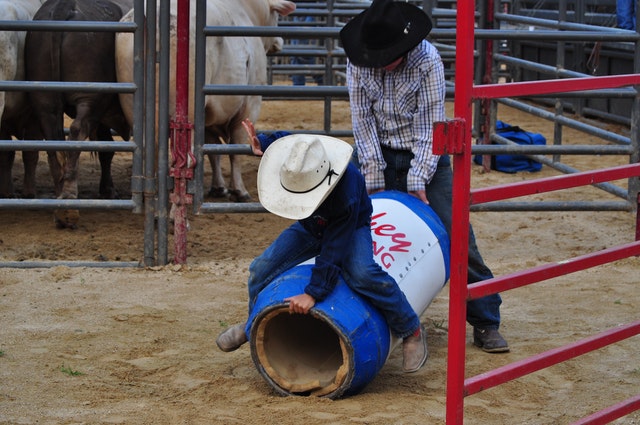
Teaching a bull riding clinic of young men and young boys on a cool weekend this fall, I settled into a gamut of trick questions in order to open up the riders ‘ thought processes and to give them examples of easy pitfalls that inexperienced riders can get bogged down in. The premise was simple; be careful of the words that are tossed around the bucking chutes and how you apply them.
For example; a person may have the best of intentions when they are supporting you as you ride, all the while screaming at you, “REACH!!! REACH for the front!!” In reality, this is probably some of the worst advice you can get and can dramatically increase your chances of an early buck-off as well as your chances for an injury. There is almost nothing about “reaching” in bull riding that is mechanically sound. Riders who learn a bad habit such as this tend to hit a brick wall in their riding that they can never seem to get around. The point I was trying to express to the group was that it is imperative that you understand what words mean for better or worse. How many of us take words and advice at face value without using our critical thinking to analyze and evaluate possible outcomes? At this point, in jest, I banned the word “reach” from the rest of the clinic. But what was more important is that I inserted a new vocabulary in place of the flawed one — this time with meaning.
In short, after some constructive conversation, open dialog, and some examples and drills on the barrels, an overwhelming look of exuberance began to appear from most of the group. They got it. They were now hungry for more and fully engaged after having a proverbial blindfold removed. The spoon-fed were now feeling like hunters after the realizations had past that not only did this new way make sense, but its truths cleared the thorny underbrush away and created a template that the riders could gauge their technique and future advices against. The words in the Bible are like this for many.
In the Gospel of John, Jesus was telling those who began following him, and those who were trying to discredit them that his true followers would follow his teaching and not that of the religious elite that were using their position to hold power over people. John 5: 31-32To the Jews who had believed him, Jesus said, “If you hold to my teaching, you are really my disciples. 32 Then you will know the truth, and the truth will set you free.”
The words of scripture can be an emancipator, setting you free. Used incorrectly the words can become an enslaver. One person can lead or mislead many out of the truest intentions depending on the level of understanding the teacher possesses and the level of spoon-fedness to which the audience may be inclined. Unfortunately, some are even led by false teachers with impure intentions. How is this possible? I believe an old bull riding adage can apply; The top 20% of riders haul in 80% of the prize money. Which means 80% of bull riders are struggling with the sport and, more often than not, donators to the purse. I believe the same is true on a more Christian front; 20% of Christians are hunters of the truth and can easily disseminate false teachings from Gospel truth. However, that means that 80% of Christians are struggling with scripture, have a loose grasp of the Gospel and are easily swayed toward the fringes where words and phrases like, “prosperity”, “morally good”, or “you’re perfect just the way you are”, run rampant and the generalized vagueness of salvation are currently leading many to despair.
I feel blessed to take a moment and think about some of my closest friends in my life and realize that they are also hunters of the truth who hold me accountable, ask tough questions, and point indiscriminately to scripture. These people are my trusted traveling partners in my walk with Christ. But just like at the bull riding clinic, I believe my friends and I have a great template to measure ourselves and our technique against. It’s the teachings from Jesus himself. Everything in the Bible from beginning to end points toward Him. During Jesus’ time on earth, he spoke only truths and eschewed many religious habits, fringe beliefs, and false teachers. And just like then, today his truth is infallible. It stands up against any test and strips the sheep’s clothing from the wolves.
John 8:32“Watch out for false prophets. They come to you in sheep’s clothing, but inwardly they are ferocious wolves.
In the end, the only way my students take the next leap in their bull riding career is if they take an infallible bull riding truth and continually apply that in practice until the correct reaction is near automatic. Likewise, there is only so much a “come-to-Jesus” moment can give us unless we affirm that newfound understanding with practice in reading Jesus’ words of truth. Therein lies the ultimate template to gauge yourself by.
Yes, your hometown church may be fine. Your mega-church may be setting attendance records. That unsubstantiated “preacher” with no church affiliation might be a likeable guy. But just ask yourself, who or what is your template based upon? It’s a fair question to spend some time on….. unless you are too busy being spoon-fed by a wolf.
Will is a retired Pennsylvania bull rider who occasionally gets back in the arena to teach bull riding schools or clinics.




Recent Comments