It can become hard to serve others when your services makes them feel like they have to return the favor. The best advice I ever received about being able to serve others in our culture is to actually ask them to serve you first.
It sounds like it goes against what the Bible teaches but here’s what happens: if I’m the new guy in the neighborhood and I try to do something for my neighbors as a way to serve them and get to know them, we unintentionally put them in the position of needing to return the favor; they owe us.
Buuuuut, if you ask THEM to help YOU first, you are now in the position of owing them a favor and unless they are just horribly unfriendly people, most are going to be willing to help you when you ask. You still get to know them, a relationship with the neighbor can start and it will be easier to serve them when opportunities arise.
My friends that explained this to me had this happen with a new family that moved in the neighborhood. I don’t remember the details but they had an opportunity to just jump in and help the family with something fairly significant but after that, found the couple was avoiding them. It wasn’t until my friends tried asking them for help that they all then started talking freely across the street and my friends realized they were being avoided because the couple felt they were in debt for the help and felt awkward.
I’m still the new person on the mountain and have a handful of neighbors where I live near Gatlinburg. One of the couples are descendants of the original family that settled the mountain and eventually sold portions of it that have become a handful of homes and rental cabins that make up our little mountain neighborhood.
When I first got up there, I did a terrible job of meeting more than the closest neighbor who sits a bit behind and above me on the ridge we share.
For awhile, we were mostly just “hey neighbors” or “wave as you go by neighbors” so for the ones I waved “hey” to the most, I decided to bake some cookies as we got close to Christmas two years ago. It’s the only time I do something like that, making shortbread like my mom had made when I was little. I had put plates of them in three neighbor’s mailboxes with Christmas cards and a note with my contact information to sort of introduce myself.
One never said anything, another put a bunch of candy canes back in mine and another didn’t find theirs until a bear had knocked the mail box over that next summer because I put them in a long-since gone relative’s box by mistake. I got a panicked voicemail from the neighbor feeling terrible that they had never acknowledged the gift, not even knowing what it was that the bear had eaten. She apologized repeatedly when I called her back because she felt terrible and I ended up feeling terrible because it had made her feel like she was in an awkward spot.
So I tried the advice I had overlooked the first time around by dropping off cookies. With the neighbor closest to me I had an extended road trip that was taking me away for more than a few weeks and I was able to meet him by actually going over to ask him if I could get him to cut my lawn once while I was away. I offered to pay but he refused.
Perfect. I now owed him.
We have visited multiple times now since then and I’ve been able to help him pile wood with no sense of obligation anymore. We now are both comfortable asking for help if we need it.
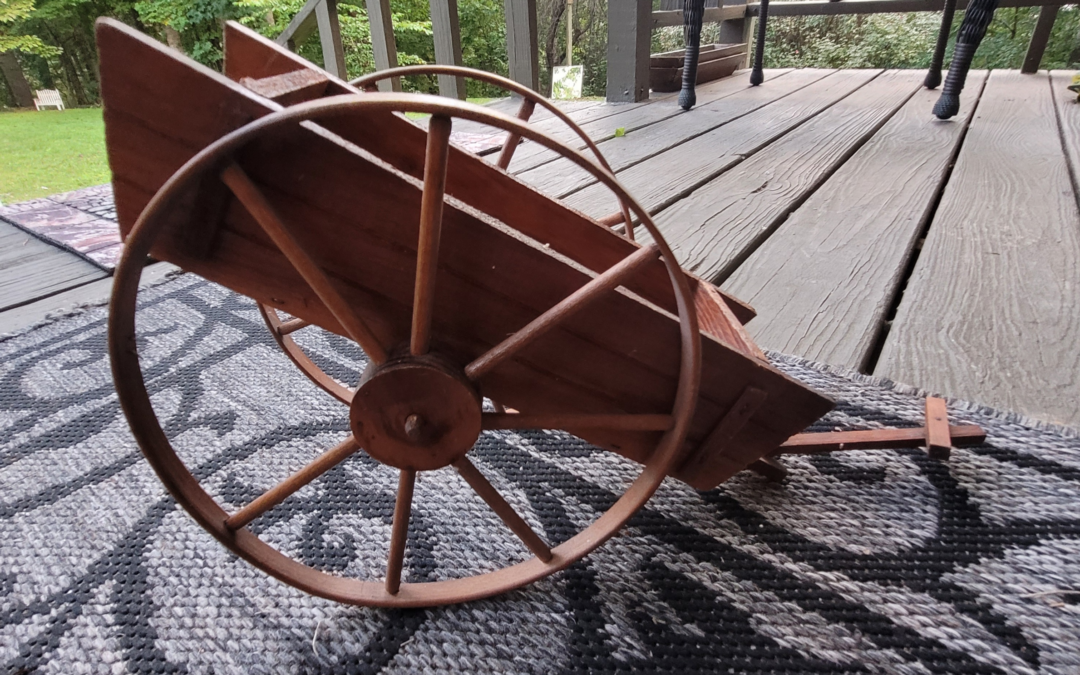
But there was still that problem with the original mountain family. That wonderful old-timey culture is deeply rooted. The phone call about the Christmas card found months later at least opened the door for me to drop in the next time I saw them outside. Caught unprepared, the wife excused herself, went inside and came out with a jar of apple butter she had made back in the fall. I had created this need for her to give back. So after a trip home to visit family in Ontario, I came the next time with a box of cookies you can only get in Canada. Because I had expressed interest in it during our conversation, I left with the moon-phase guide to planting a garden they kept on their refrigerator. Next time, having learned she couldn’t eat much sugar, I came with some chips in a style you can only get in Canada and left with a wooden wagon planter from her porch.
Finally, a couple weeks ago, I was getting ready for another trip to Ohio and Ontario when my covid test for the border crossing came back inconclusive and I was going to have to go to town again to take another test. At the same time, my lawn tractor backfired and died on me right as the husband was driving by on his own to cut the lawns on the two rental cabins down from me. I really did need some help and was able to approach him to ask if he had enough gas and time to keep cutting one more while I ran back to town for the second test.
He wouldn’t accept offer of payment and also said he’d help figure out what was wrong with the mower when I get back.
My hope is that by finding myself in real need of help, this has broken the cycle of gift-giving and opened the door to where they won’t mind asking me for help or that I can pitch in when I see a need without having to be given something off their porch.
Philippians 2:3-4Do nothing out of selfish ambition or vain conceit. Rather, in humility value others above yourselves, 4 not looking to your own interests but each of you to the interests of the others.
The idea of asking for help instead of offering it seems contrary to scripture except it can be an effective way to build a bridge that opens the door to more easily serve those neighbors and develop a closer relationship that allows the gospel to be shared.
Rodeo and bull riding give us all a great opportunity to ask for help and I think in that environment, it’s easier for us to do it either way. If we need help, we’re going to ask for it and if we see someone who needs help, most of us are pretty good at stepping up and helping without being asked. It’s just a natural way of doing things so it doesn’t create that sense of obligation.
But what are some ways we can either serve or ask to be helped in order to build connections with others around us outside the sport? We help others so we can show Jesus to them but however we do it, we need to build connections so we can also tell them who Jesus is and what he did for them.
The past year, on top of the personal struggles we face, we were all dealing with struggles that the pandemic brought from lock downs to canceled rodeos and horse shows.
Lost work, lost business, lost time with family gave us a lot to feel angry about.
And everyone knows it.
Whether it be on social media or face-to-mask conversations, we all have had a lot to say about how we feel and very little of it has been positive or encouraging. In the rodeo and bull riding industries, we continually talk about mindset and keeping positive attitudes. We rarely talk about that from a faith perspective.
The apostle Paul does in many ways in several of his letters. In Philippians, his letter to the church at Philippi, Paul writes many encouraging passages about being cheerful and Christ-like in our mindset and responses to our situations including one encouragement about our attitude when life might be rough.
Philippians 2: 14-16 Do all things without grumbling or questioning, that you may be blameless and innocent, children of God without blemish in the midst of a crooked and twisted generation, among whom you shine as lights in the world,
When we have a saving faith in Jesus, we are given what’s known as the Great Commission to respond to at the end of the Book of Matthew. The commission commands us to tell others about Jesus and the salvation he brings and then to make disciples—teach others how to follow Christ.
That means being out there in an unbelieving world that generally rejects the messages of Jesus or sees him as no more than a positive teacher back in his day.
But if we are to convince others that Jesus was the Son of God who died in place of our sins that through belief and repentance of our sins, we can be saved from the punishment meant for our sins, it’s going to be a lot harder if they can’t see signs of Jesus in us.
The amount of complaining and fighting many of us have done over the past year would make it hard for others to see us as different than them. If our lives have been changed by a saving faith in Jesus, there are times when our actions or responses should surprise people by how different they are from everyone else.
Paul wanted the Christians in Philippi to be seen as ‘children of God’ that stood out among the evil that was around them and showed the light of Christ.
As Christians, we’re called to be like Christ, but we understand we’ll never truly be as perfect as him. We’re going to make mistakes. Admitting them to an unbelieving world and telling them that as Christians, we meant to do different is one step toward repairing any damage from our words or actions. Moving forward by ending our grumbling and taking a more joyful or kind approach to our situations can begin to show others that Christ lives inside of us.
Last year, I jokingly posted to social media an online order for a cattle prod. I don’t have cattle. It was a tool I wanted to carry with me to keep people the full six feet away from me that we were learning was part of the guidelines for dealing with the pandemic we were just beginning to face.
But all of Scripture isn’t about keeping people at a distance, it’s about God wanting us to be with Him, free from His judgment of our sin.
James 4: 7-10Submit yourselves, then, to God. Resist the devil, and he will flee from you. 8 Come near to God and he will come near to you. Wash your hands, you sinners, and purify your hearts, you double-minded. 9 Grieve, mourn and wail. Change your laughter to mourning and your joy to gloom. 10 Humble yourselves before the Lord, and he will lift you up.
James gives us just one of several direct references in the Bible of God wanting us to draw near to Him. Here, he is stressing the importance of turning from sin and repenting, first by telling us to submit to God, fight the devil and the temptation of sin and to turn to God instead.
James tells us if we move toward God, God will come toward us but stresses we approach God with a heart purified of sin.
Regardless of how people have felt about the pandemic and how it has been handled across the country and around the world, we’ve spent the past year either fighting against being kept apart from each other in our communities and churches or we’ve been willingly staying apart in effort to protect people we care about like vulnerable grandparents. Either way, it’s been difficult and challenging for Christians who understand we’re meant to be in community together just like we’re meant to be close to God.
We’ve been dealing with a lot of situations that have felt contradictory to what we believe.
And James gives us another seemingly contradictory statement in verse nine.
Here, he tells us something that sounds like it’s contradictory. We know through other books of the Bible and through our own experiences that our salvation brings about joy, understanding that when we have a saving faith in Jesus, we have gained a perfect eternity in Heaven. Fruit of the Spirit is something that forms in us when our salvation is real and one of those fruits is joy. Yet James is telling us to grieve and move from joy to gloom.
But what James is telling us in this single verse is just how serious our repentance of sin should be.
Our sin separates us from God and He will judge and condemn it. But He sent Jesus to briefly live among us, close to us, fully God and fully man. While his disciples didn’t understand it at the time, Jesus was here to die and take the full punishment that was meant for them and all of us. Through his sacrifice, we could be restored to a right relationship with God. Through believing Jesus was the son of God, died for our sins and was resurrected, we must repent of our sin and ask to be forgiven. When our faith and repentance is real, we’re given a perfect, eternal life in Heaven instead of eternal punishment in hell.
James wants us to grieve our sin that has kept us separated from God. He wants us to be humble before God but with the understanding God will come close to us—close enough to ‘lift us up.’
How wonderful is that to worship God who despite all our mistakes and failings, wants to be that close to us?
Ever misunderstood something and felt pretty dumb about it afterward?
Sometimes it’s easy to misunderstand something in the Bible and I think that keeps many of us from reading it. Seminaries teach pastors Greek and Hebrew to help them understand what you’re sitting there scratching your head to understand. Try anyway.
There are more parts that ARE easier to understand than others and just like the awkwardness of learning to handle yourself in the bucking chutes, the first time you try to load a horse on the trailer or the first time you try to turn a rope over your head, it gets easier.
Having a church helps where there are pastors and leaders that can help you understand it. I sometimes need that before I try to deliver a cowboy church sermon behind the chutes and am fortunate enough to have more than a dozen people I know that understand it better than me. When I’m not certain my interpretation or application is right, I can run a section of scripture by to be sure I understand it right. There are also great study bibles out there with notes that help explain it and an internet full of resources though you have to be careful what you follow.
Don’t get hung up on feeling dumb for not understanding something. Be encouraged by the work God and the Holy Spirit will do inside you through the parts you do understand and step by step, more and more of it will make sense.
And step by step, you will see even more, just how big God really is. A passage in the Old Testament suddenly makes sense in how it points to Jesus in the New Testament. A passage in the New Testament’s Ephesians that used to be confusing begins to make more sense because you see how it builds on something Jesus taught in the book of Mark. The more you learn, the more you change and grow.
See what you can learn about the importance of reading your Bible from the two verses below.
2 Timothy 3:16-17 All Scripture is breathed out by God and profitable for teaching, for reproof, for correction, and for training in righteousness, 17 that the man of God may be complete, equipped for every good work.
Scripture is God’s living word in how it’s described as being ‘breathed out’ by God. And we see clearly how important it is for so many parts of our lives, teaching us how to be more like Jesus as it describes training in righteousness. It shows us that it will help us with any good effort we take for God as it tells us it will prepare us for “every good work.”
I didn’t understand what a ‘good work’ was at first. I didn’t understand what righteousness was at first. But as I understood those terms and ideas, 2 Timothy is now a favorite verse to teach to others because it helps us understand the many different reasons the Bible is important for us.
The more time you give it, the more it will make sense and benefit you.
Just like Christianity insists there is only one true God and one path to Heaven, there is only one blessing that we should be seeking and that’s the one found through a saving faith in Jesus Christ.
Just as Adam and Eve brought a curse on us that saw us separated from God, facing His judgment and wrath against our sin, God also brought a blessing to us in the form of a covenant centered around Jesus Christ.
A covenant is a promise in the biggest possible way and one that doesn’t require anything from us in return. When we compete for a season to qualify for a rodeo finals, there is an assumed promise that the payout is going to be there when we reach the finals. Yet most of us know stories or have experienced either a finals that didn’t occur or prize money that wasn’t there after we did the work to get there. This covenant from God is a promise that you never have to worry won’t be kept and that you never have to earn.
God made one in the Old Testament with Abraham, promising him that he would make a great nation from Abraham’s descendants and that those people who followed the God of Abraham, would be blessed.
Genesis 12: 1-3Nowthe Lord saidto Abram, “Go from your countryand your kindred and your father’s house to the land that I will show you. 2And I will make of you a great nation, and I will bless you and make your name great, so that you will be a blessing.3 I will bless those who bless you, and him who dishonors you I will curse, and in you all the families of the earth shall be blessed.”
The Israelites, Abraham’s descendants, were lead to a promised land to fulfill that covenant (promise) but failed repeatedly to honor and follow God. As a result, the Israelites were exiled from that promised land and only a remnant of those people were given back Jerusalem, the land from which they had been exiled. Those descendants, now us, would go on to see God make a new covenant fulfilled through the New Testament and the coming of Jesus so that everyone (Gentiles), not just the Jews of Israel could be made right with God.
Galatians 3:7-9Know then that it is those of faith who are the sons of Abraham. 8 And the Scripture, foreseeing that God would justify the Gentiles by faith, preached the gospel beforehand to Abraham, saying, “In you shall all the nations be blessed.” 9 So then, those who are of faith are blessed along with Abraham, the man of faith.
Jesus died on the cross as a sacrifice and to take the punishment for our sins that God must deliver to be a just and right God. Through a saving faith in Jesus and repentance of our sins that separate us from God, we’re no longer seen as sinner but the perfect people God made us to be and we are assured then a place in Heaven for eternity.
That is the blessing found in Jesus Christ that was set up thousands of years ago in the Old Testament through that promise to Abraham and what is referred to in the blessings mentioned in the verses above.
Remember, often when we say we are ‘blessed’ and use that hashtag, what we really mean is that we’re thankful. Every good experience or gift or circumstance is something we can understand has come from God and is something we can be thankful for. But the ultimate blessing is knowing we can be saved through Jesus Christ and inherit a perfect eternity with God in Heaven.
Without Jesus, the good things we see as blessings do nothing for us when it comes to eternal life in Heaven. They are temporary good moments in this evil world but we remain under the curse and condemned to hell under God’s judgment and wrath unless we find the real blessing God gave us through Jesus Christ.
God made a promise to us through a covenant in the Old and New Testament that leads to us being able to trust that our salvation is found in Jesus Christ and that a perfect life in Heaven can be found through a saving faith in Him.
We may not always trust a promise made to us by someone in rodeo, but when God made a covenant with His people, He made a promise that the prize would be there at the end.





Recent Comments