by admin | Dec 13, 2025 | Behind the Bucking Chutes
By Scott Hilgendorff / Cowboys of the Cross
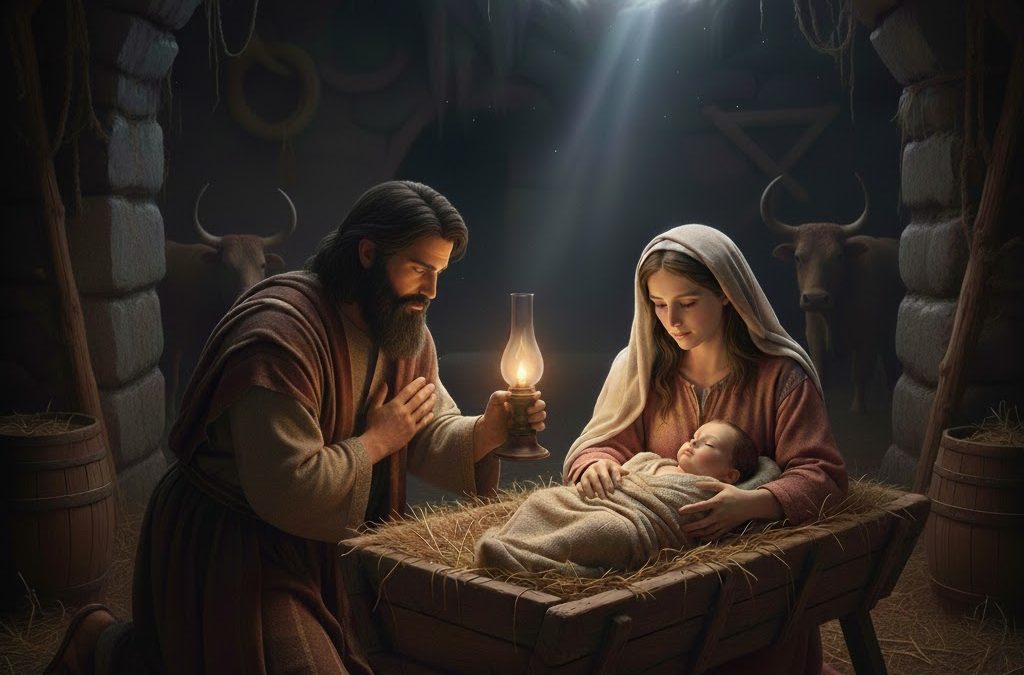
Chances are, Jesus wasn’t born in a stable. That doesn’t make his birth any less humble.
The idea of donkeys and cattle being gathered around is not as likely either.
Those ideas, while appealing to cattlemen, ranchers and cowboys, came along later and now, we grow up singing Christmas carols and songs that reference them and as kids, we grew up with television specials that depicted those kinds of images. Those images are everywhere from expensive pieces of art and home decor to jigsaw puzzles and Christmas cards. It’s understandable that we would make these assumptions when we consider the Christmas story.
I remember as a new believer, hungry to learn more from God’s word every day, that I was looking forward to adding reading what we call the Christmas story from Luke 2, into my Christmas traditions. Christmas morning, I opened my Bible and settled in to read through it. By verse seven, it was all but over in less than a minute of reading.
Luke 2:7 “And she gave birth to her firstborn son and wrapped him in swaddling cloths and laid him in a manger, because there was no place for them in the inn.”
There was no urgent knocking on doors in effort to find a place to stay as Mary was in labor. There was no description of the stable or animals gathered around. The story does continue with an angel of the Lord appearing before shepherds and of their journey to see the newborn Savior but there are very few details describing that manger scene we can all picture in our minds.
The manger, a feeding trough, is our clue that there likely were animals present and Jesus’s birth most certainly was still humble, but according to Steve Mathewson from an article with The Gospel Coalition. Most English translations of the Bible use the word inn but the Greek word being used is “katalyma” which, in two other places of the Bible, Mark, 14:14 and Luke 22:11, translate to “guest room.”
In that time period, historical understanding tells us there was often a downstairs room where animals might be kept for their heat and to keep them protected and it’s likely because there was no room in the guest room where they hoped to stay, Jesus was born in a downstairs family room where a feed trough, a manger, would still be present to feed the animals brought in there at night.
It just doesn’t leave room for donkeys and cattle.
It doesn’t mean we should stop singing, “Away in a Manger” and “The Little Drummer Boy;” it means we need to remind ourselves how careful we have to be with God’s word. It’s easy to let our culture influence how we interpret scripture when it’s scripture that needs to influence our culture.
As we think about the Lord’s humble birth and being placed in that manger, a powerful scene from our Christmas stories of an angel of the Lord appearing to a group of shepherds, an ancient version of modern cowboys, to tell them of Jesus’s arrival.
Then, even more stunning, in Luke 2:13, “Suddenly a great company of the heavenly host appeared with the angel, praising God…”
The shepherds went to see Jesus and from all their experiences, went home praising and glorifying God.
Whether or not Jesus was born in a stable, Jesus’s birth was still both humble and spectacular from the manger to the presence of countless angels before the shepherds.
These are details we know for certain from Scripture and are our inspiration to praise the arrival Jesus just the same as the shepherds this Christmas season, letting our celebration be one that praises God for what He did for us in sending a Savior to die for our sins. His death and resurrection gives eternal life to those repentant of their sins, seeking forgiveness through a saving faith in who Jesus was, born that day in a manger, and who he is now in Heaven.

by admin | Dec 5, 2024 | Behind the Bucking Chutes
By Scott Hilgendorff / Cowboys of the Cross
As cowboys, whether on the ranching or the rodeo side, you aren’t afraid of hard work and you know how to be tough.
When it comes to difficult personal situations, now matter how tough we are, it isn’t always easy to ‘do the hard thing.’
When is the last time you gave a sincere apology when you messed up? When is the last time you admitted you messed up in the first place? I think pride sometimes makes us feel like doing the right thing is a sign of weakness.
It’s actually just the opposite and it’s Joseph in another part of the Bible’s teachings on the birth of Christ, that shows us this. The verses in the second chapter of Luke are often referred to as “The Christmas Story” but in another part of the teachings about Jesus’s birth in Matthew 1, Jospeh shows us what it really means to do the hard thing.
Matthew 1:18-25 Now the birth of Jesus Christ took place in this way. When his mother Mary had been betrothed to Joseph, before they came together she was found to be with child from the Holy Spirit. 19 And her husband Joseph, being a just man and unwilling to put her to shame, resolved to divorce her quietly. 20 But as he considered these things, behold, an angel of the Lord appeared to him in a dream, saying, “Joseph, son of David, do not fear to take Mary as your wife, for that which is conceived in her is from the Holy Spirit. 21 She will bear a son, and you shall call his name Jesus, for he will save his people from their sins.” 22 All this took place to fulfill what the Lord had spoken by the prophet: 23 “Behold, the virgin shall conceive and bear a son,and they shall call his name Immanuel” (which means, God with us). 24 When Joseph woke from sleep, he did as the angel of the Lord commanded him: he took his wife, 25 but knew her not until she had given birth to a son. And he called his name Jesus.
Mary’s pregnancy would only be seen as adultery in this culture without them being able to understand God’s plan. The consequences for Mary would be facing being stoned to death. The consequences for Joseph were tremendous shame but again, in that culture, it would be far more devastating than what we can understand today.
But without yet knowing God’s plan, Joseph already sets a standard that is hard to meet: he is willing to end his betrothal quietly to prevent Mary from harm. Then, when the angel appears in the dream, he does something even harder: he marries her knowing he is not the father of her child but ensuring she is protected and the baby, a savior of us all, would safely be born.
This is what it means for a man to do the hard thing.
Most of us aren’t going to face a situation as difficult as what Joseph faced. But some of us will. Some of us might find ourselves in a situation where we have to turn in a family member for a crime or push someone into rehab who is screaming how much they hate us for it when we know it’s the right thing for them and for us as Christians.
All of us will have some opportunity on some level to do what we know is right when it’s hard. Confessing our sin is hard. Admitting a mistake and asking to be forgiven. Paying back a debt months or even years after a friendship was ruined by it. There will be moments ahead for each of us to set aside our pride and even face a little shame or embarrassment in order to “do the hard thing” by doing the right thing.
Sometimes what the right thing to do is perfectly clear in scripture but sometimes it isn’t. When that’s the case, pray, seek advice from a pastor or a fellow Christian and then always check that advice with Scripture. The right thing will never go against God’s word. No matter how hard it is, think about what Joseph did.
Do the hard thing anyway. There’s nothing weak about that.

Recent Comments